_edited%20copy.png)
A Guide to Commercial Equipment Services
- Aug 21, 2025
- 18 min read
When your business relies on heavy-duty equipment, you can't afford to just cross your fingers and hope it doesn't break down. Commercial equipment services are about more than just having a number to call when something goes wrong; they're about creating a strategic partnership to keep your most critical assets running smoothly and for as long as possible.
It’s a fundamental shift in thinking. Instead of scrambling to fix a broken machine (the reactive approach), you get ahead of problems with a proactive plan that keeps everything in peak condition. This isn't just a nice-to-have—it's a direct investment in your operational stability and your bottom line.
Understanding the Core of Equipment Services
Think of your equipment service provider less like an emergency mechanic and more like a wellness coach for your machinery. Just like a personal trainer builds a program to prevent injuries and boost performance, a service provider develops a strategy to keep your equipment humming along without a hitch.
This proactive mindset is non-negotiable for any business that depends on its machinery to make money, serve customers, or keep its environment safe. From a restaurant kitchen's walk-in freezer to a factory's conveyor belt, a single failure can set off a disastrous chain reaction. We're talking lost revenue, spoiled inventory, missed deadlines, and a damaged reputation.
Shifting from Reaction to Prevention
The real goal here is to break the expensive cycle of unexpected breakdowns. When you're stuck in a reactive mode, downtime is a given. Repairs are always a frantic, high-pressure affair, which almost always means you're paying more for emergency labor and rushed parts.
Proactive service flips the script by catching potential failures before they ever happen. This isn't a niche concept; it's a massive global industry. The market for commercial and industrial equipment repair was valued at around $187 billion, which shows just how critical this work is for keeping businesses productive. This industry covers everything from routine tune-ups to emergency fixes for HVAC systems, refrigeration units, and manufacturing machines. You can dig into more data on this vital market at Kentley Insights.
The true value of professional equipment services isn't just fixing what's broken; it's creating an operational environment where failures are rare, predictable, and manageable.
What This Means for Your Business
When you partner with a dedicated service provider, you're bringing on a team that's just as invested in your success as you are. This relationship gives you a serious edge, directly impacting your financial health and day-to-day efficiency.
Here’s a look at the core components that make up a strong service program:
Core Components of Equipment Service Programs
A quick overview of the primary service types that form the foundation of a comprehensive equipment management strategy.
Service Component | Primary Goal | Business Impact |
|---|---|---|
Preventive Maintenance | Stop problems before they start through regular check-ups, cleaning, and adjustments. | Dramatically reduces unexpected downtime and extends the life of your equipment. |
Predictive Analysis | Use data and technology to forecast when a part or machine is likely to fail. | Allows for scheduled, non-emergency repairs, saving money and avoiding chaos. |
Emergency Repair | Provide fast, expert response when an unexpected breakdown does occur. | Minimizes the impact of failures on revenue, inventory, and customer experience. |
Asset Management | Track the entire lifecycle of your equipment to make smart decisions about repairs vs. replacements. | Maximizes the return on your initial investment and helps plan for future capital expenses. |
By having these services in place, you get a clear, practical advantage in several key areas.
Minimized Downtime: Scheduled maintenance and smart analysis catch small issues before they snowball into catastrophic failures, keeping your business online.
Extended Asset Lifespan: Proper care, calibration, and cleaning help your expensive equipment go the distance, getting you the most bang for your buck.
Improved Safety and Compliance: Regular inspections ensure your machinery meets all the necessary safety regulations, protecting your team and your business from liability.
Predictable Budgeting: A solid maintenance plan turns surprise repair bills into a fixed, manageable operational expense. No more guesswork.
Think about a restaurant that invests in routine care for its cooling systems. It’s not just about avoiding a meltdown during a dinner rush; it’s about preventing food spoilage and keeping customers comfortable. For more on this, check out our guide on how to keep your commercial refrigerator running at peak performance.
Ultimately, professional equipment services aren't a cost center. They're an investment in stability, predictability, and peace of mind.
The Four Pillars of Equipment Service
Great commercial equipment services are built on four key pillars. Each one supports your equipment at a different point in its lifecycle, and together they create a solid strategy to prevent failures, fix problems fast, and make sure everything runs right from day one.
Think of it like building a house. If you skimp on one of the foundational pillars, the whole structure becomes shaky. In your business, that stability means smooth operations, happy customers, and a healthier bottom line.
Pillar 1: Preventive And Predictive Maintenance
The first and most important pillar is all about being proactive. This isn't about fixing broken things; it's about stopping them from breaking in the first place. This approach is really split into two smart strategies.
Preventive Maintenance: This is your equipment's regular check-up. It includes scheduled inspections, cleaning, lubrication, and small adjustments based on the manufacturer's guidelines and how much you use it. It's just like getting an oil change for your car—a simple, predictable step that prevents a massive engine failure later on.
Predictive Maintenance (PdM): This is a bit more high-tech. It uses technology to guess when a part might fail before it actually does. Technicians use tools like vibration analysis, thermal imaging, and sensor data to pick up on tiny signs of wear and tear. This lets them swap out a failing component during a planned downtime, not in the middle of a busy workday.
This proactive mindset is what separates businesses that are thriving from those constantly putting out fires. A restaurant that services its walk-in freezer before the summer rush is the one that avoids a disastrous failure on a holiday weekend, saving thousands in lost inventory.
Pillar 2: Corrective And Emergency Repairs
No matter how great your maintenance plan is, things can still go wrong. That’s where the second pillar comes in: fast, effective repairs. The goal here is simple—get you back up and running with as little downtime as possible.
Corrective repairs handle issues found during routine checks that aren't quite emergencies yet. For instance, a technician might spot a worn-out belt on an HVAC unit and schedule it for replacement next week. It’s a planned fix that stops a bigger, more disruptive problem from happening.
Emergency repairs, on the other hand, are the all-hands-on-deck moments. This is when your kitchen's exhaust hood gives out mid-service or the AC dies on the hottest day of the year. A dependable service partner has technicians ready to go 24/7 to handle these crises. You can learn more about what our commercial AC repair services include and how we tackle these urgent calls.
A great service partner really shows their worth in a crisis. Their ability to quickly figure out the problem, find the right parts, and make a solid repair under pressure is what shields your business from the true cost of downtime.
The infographic below shows just how much a strong maintenance and repair plan can do for your business.
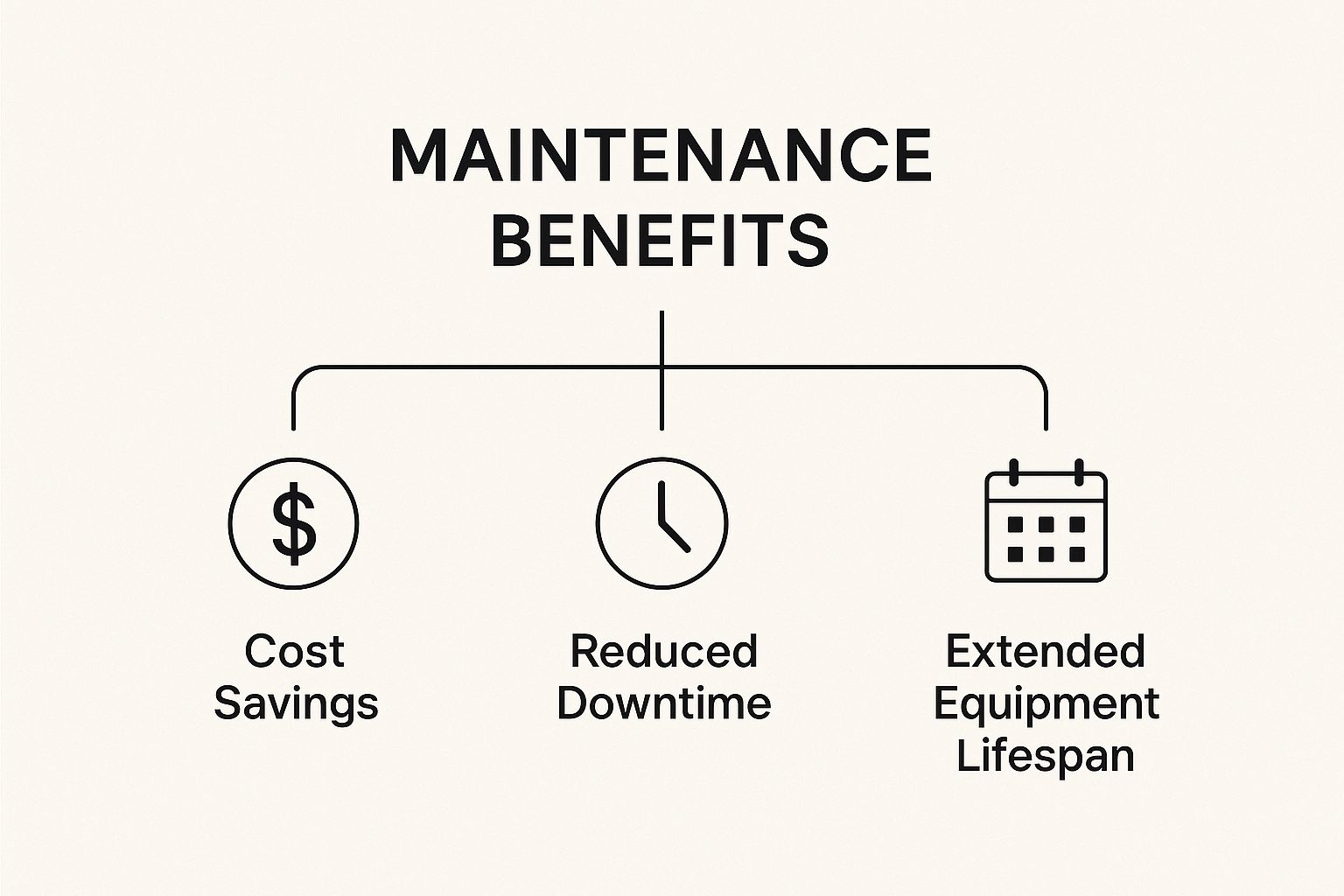
As you can see, being proactive directly leads to big savings, fewer interruptions, and a longer, more productive life for your equipment.
Pillar 3: Professional Installation And Commissioning
The third pillar is all about starting off on the right foot. A proper installation is absolutely critical for the long-term health and performance of your equipment. A sloppy setup can cause all sorts of chronic problems, from poor efficiency to early breakdowns—and it can even void your warranty.
Commissioning is just a technical term for the final quality check. It’s the process where technicians test and confirm that the new equipment is installed perfectly and running exactly as it should. It’s the final step that ensures a smooth handover to your team.
For example, installing a new commercial oven is way more than just plugging it in. A professional will make sure it’s properly ventilated, calibrated for precise temperatures, and safely hooked up to your gas or electrical systems. That's what sets it up for years of reliable service.
Pillar 4: Calibration And Compliance Services
Finally, the fourth pillar keeps everything precise and up to code. Many industries, like healthcare and food service, have to follow strict rules about equipment accuracy and safety.
Calibration services make sure your machines give accurate readings and work within tight tolerances. For a commercial scale, a lab centrifuge, or a temperature-controlled fridge, being accurate isn't just a suggestion—it's essential.
Compliance services help you stay on the right side of industry regulations, like health codes and safety standards. A good service provider keeps up with these rules and ensures your equipment will pass any inspection, protecting your business from fines or legal trouble. This pillar gives you peace of mind, knowing your operations are not just running well, but are also safe and legal.
How Different Industries Depend on Equipment Services

While every business needs reliable equipment, what that looks like can change dramatically from one industry to the next. A minor hiccup in one type of business can be a full-blown catastrophe in another. This is why a one-size-fits-all approach to commercial equipment services just doesn't cut it.
For any company, equipment is an investment. But for places like restaurants, hospitals, and factories, it’s the heart of the entire operation. Let's dig into how these sectors rely on expert services not just to stay open, but to actually succeed.
Food and Beverage: The Industry of Absolute Uptime
In a restaurant or commercial kitchen, equipment failure isn't just a bump in the road—it’s a direct threat to your bottom line, your reputation, and even public safety. Imagine a walk-in freezer failing overnight. You're looking at thousands of dollars in spoiled food. Or picture a commercial oven giving out during the dinner rush, leaving you with lost sales and angry customers who might not come back.
In this world, uptime is everything. The spotlight is always on refrigeration and cooking equipment, where steady performance is directly linked to food safety rules and keeping customers happy. The market reflects this urgency; the global commercial refrigeration sector hit USD 44.44 billion and is projected to climb to nearly USD 80 billion by 2034. The U.S. alone accounts for $9.77 billion of that.
For these businesses, essential services look like this:
Rapid Emergency Response: Having a team on call 24/7 is crucial for fixing a broken cooler or a failing AC unit before it causes chaos.
Routine Preventive Checks: This means regular coil cleanings, thermostat calibrations, and seal inspections to stop breakdowns before they start.
Compliance Verification: Making sure every piece of equipment is up to snuff with strict health department standards.
Proper upkeep isn't just about dodging repair bills. It’s about ensuring the food you serve is safe and high-quality. If you want to learn more, check out our guide on what you need to know about commercial HVAC and refrigeration maintenance.
Manufacturing: Where Every Second Counts
Momentum is king on the factory floor. The whole operation is like a complex machine, with each piece of equipment playing its part in a long chain of events. When one link in that chain breaks, the entire production line can grind to a halt, creating a bottleneck that costs a fortune.
In manufacturing, downtime is measured in lost products, blown deadlines, and massive financial hits. Just one hour of a key assembly line being down can cost a company tens of thousands of dollars. So, equipment service here is less about simple repairs and more about keeping the whole production process flowing smoothly.
For manufacturers, equipment maintenance is not a cost center—it is a production strategy. Predictive analytics and proactive repairs are the tools that protect the factory's most valuable asset: time.
Service priorities in this sector are all about being predictable and efficient.
Predictive Maintenance (PdM): This involves using sensors and data to guess when a part might fail before it actually breaks.
Scheduled Shutdowns: Smartly planning maintenance during off-hours to avoid disrupting production.
Precision Calibration: Making sure every machine is running at its exact specifications to keep product quality high.
Comparing Industry-Specific Service Needs
It's clear that what's "critical" for a restaurant is different from what a factory or hospital needs. Each sector's business goals drive its maintenance priorities. This table breaks down the core focus for each.
Industry Sector | Top Priority Service | Key Business Driver |
|---|---|---|
Food & Beverage | Emergency Refrigeration & HVAC Repair | Preventing inventory loss and ensuring food safety |
Manufacturing | Predictive Maintenance & Calibration | Maximizing production uptime and minimizing defects |
Healthcare | Compliance & Precision Maintenance | Guaranteeing patient safety and diagnostic accuracy |
Ultimately, understanding these unique drivers is what separates a generic repair service from a true maintenance partner that helps a business thrive.
Healthcare: The Zero-Fail Environment
Nowhere are the stakes higher than in healthcare. Here, equipment services aren't just about business—they're about patient safety. A failing diagnostic machine, a faulty life-support system, or an uncalibrated surgical tool can have life-or-death results. There is zero room for error.
The focus is squarely on precision, unwavering reliability, and meeting tough medical regulations. Equipment like MRI machines, ventilators, and sterilizers has to be perfectly maintained and calibrated to be both safe and effective for patient care.
Technicians working in this field need special training to handle sensitive medical gear. Their work allows doctors and nurses to make accurate diagnoses and provide life-saving treatments with confidence, making equipment service a core part of the patient care ecosystem.
The Future Is Equipment as a Service
The old way of buying commercial equipment is pretty simple: you cut a huge check, and the machine is yours. But that straightforward approach has some serious downsides. It ties up a ton of cash and puts all the pressure of maintenance, repairs, and eventual replacement right on your shoulders. Now, a new model is flipping that idea on its head, treating high-performance machinery less like a one-time purchase and more like a subscription you’d have for software.
This is the whole idea behind Equipment as a Service (EaaS). Instead of buying a state-of-the-art manufacturing robot or a high-capacity commercial oven, imagine paying a predictable, recurring fee to use it. This isn't just a simple lease, either—it’s a complete service package. That fee covers the equipment itself, plus all the preventive maintenance, performance monitoring, and emergency repairs needed to keep it running without a hitch.
Think of it like subscribing to Netflix instead of buying a massive DVD collection. You get access to everything you need without the massive initial investment, and you never have to worry about the discs getting scratched or becoming obsolete.
Shifting from Capital to Operational Expenses
One of the biggest wins with EaaS is how it completely changes your company's financial picture. It moves the cost of equipment from a huge Capital Expense (CapEx) to a manageable Operating Expense (OpEx).
CapEx (Capital Expense): This is that big, one-time purchase that sits on your balance sheet as an asset. It often requires jumping through hoops for budget approval and can hamstring your ability to invest in other parts of the business.
OpEx (Operating Expense): This is a regular, predictable cost paid out of your operational budget. It makes financial planning way easier and frees up your capital for other things, like marketing or hiring.
For small and medium-sized businesses, this shift is a total game-changer. It gets rid of the massive upfront investment, giving them access to the same top-tier technology that larger corporations have been using for years. A startup restaurant can get a premium refrigeration system without draining its funding, letting it compete on a more level playing field from day one.
This isn't some niche concept, either—it's exploding. The global Equipment as a Service market was valued at USD 1.51 billion in 2023 and is on track to hit nearly USD 27.8 billion by 2030. That kind of growth shows just how fast businesses are catching on to this smarter approach. You can discover more insights about this market trend and its impact at Grand View Research.
A True Partnership in Performance
Maybe the most powerful part of the EaaS model is how it aligns your goals with your service provider’s. In the traditional setup, a provider often makes their money when your equipment breaks down. With EaaS, the exact opposite is true.
Under an Equipment as a Service agreement, the provider only succeeds when your equipment is running perfectly. Your uptime is their business model.
This creates a real partnership. The provider is now deeply motivated to handle preventive maintenance perfectly, use the best parts, and jump on issues immediately, because any downtime for you directly hits their bottom line. They have a vested interest in keeping your machinery in peak condition, making sure you get the performance and reliability you’re paying for. This shared goal builds a stronger, more collaborative relationship and fundamentally changes how businesses look at their most critical assets.
How to Choose the Right Service Provider

Picking the right partner for your commercial equipment services is one of the most important calls you’ll make for your business. It’s about much more than just finding the cheapest quote. A low-cost provider who is slow to show up or doesn’t have the right skills will end up costing you a fortune in downtime and lost business.
Think of it like hiring a key team member. You're not just filling a slot; you're bringing on a partner you can trust with your most critical assets. You need someone who is reliable, skilled, and understands what makes your business tick.
Evaluate Technical Expertise and Certifications
First things first, you have to confirm the provider's team actually has the right skills for your equipment. Your machinery is complex and expensive, and you can’t afford to let someone learn on the job. Don't be shy about asking for the specifics on their team’s training and qualifications.
Look for technicians certified to work on your specific brands and types of equipment. Certifications from groups like NATE (North American Technician Excellence) or CFESA (Commercial Food Equipment Service Association) are a great sign that they’re committed to high standards and ongoing training.
A team with the right training is far more likely to get the diagnosis right the first time, make repairs that last, and keep your equipment running the way it was designed to. That expertise saves you from repeat service calls and keeps everything running safely and efficiently.
Scrutinize Response Times and Availability
When a critical piece of equipment goes down, every single minute of downtime is money out the window. Your service provider's ability to respond fast isn't a bonus—it's a must-have. A cheap contract means nothing if their tech can’t get to you for 48 hours while your operation is at a complete standstill.
Get clear on their emergency service policies before you sign anything. A true partner should offer 24/7/365 availability for those urgent, middle-of-the-night breakdowns.
A provider's true value is often revealed during a crisis. Guaranteed emergency response times are your insurance policy against prolonged operational disasters.
Ask them directly about how they operate. Do they have enough technicians to handle their current clients without long waits? What's their average response time for both regular and emergency calls in your neighborhood? The answers will tell you everything you need to know about how well they can support you when it counts.
Confirm Service Area and Local Presence
A provider’s geographic coverage is another simple but crucial factor. If you have more than one location, you need a partner who can service all of them without a drop in quality. Juggling different vendors for different sites is a logistical nightmare that leads to inconsistent service.
Having a local presence is a huge advantage, too. Technicians who are already in your area can get to you much faster during an emergency. Plus, local pros often have a better feel for regional issues, like how the Florida climate impacts HVAC and refrigeration systems. For a deeper dive on this, check out our post on why local HVAC contractors often beat national chains, especially for restaurant needs.
Demystify the Service Level Agreement
The Service Level Agreement (SLA) is the most important document in this entire relationship. It's the contract that spells out exactly what the provider is promising your business. A vague or poorly written SLA leaves you exposed, so you have to review it with a fine-tooth comb.
A solid SLA should clearly define a few key things. Here’s what to look for:
Guaranteed Response Times: The contract must state, in writing, how quickly a technician will be on-site for different issues (e.g., within 2 hours for emergencies, 24 hours for standard calls).
Uptime Guarantees: For your most critical equipment, some providers will guarantee a certain amount of operational uptime, like 99.9%, and offer credits if they don't hit that mark.
Clear Scope of Work: The document needs to detail exactly what’s covered, including labor, parts, and the types of service calls included in your plan.
Penalty Clauses: A strong SLA will include penalties or remedies if the provider fails to deliver on their promises.
Don’t sign anything until every single detail is crystal clear. A transparent and thorough SLA is the bedrock of a healthy, long-term partnership built on trust and accountability.
Taking an Active Role in Equipment Health

While hiring a skilled service provider is the most important step in any maintenance strategy, your own in-house team plays a huge supporting role. What your staff does every day can make or break the lifespan and performance of your equipment, creating a powerful partnership with your service technicians.
When you build a culture of care internally, your employees become your first line of defense against surprise breakdowns. It shifts maintenance from something that just happens to your equipment into a shared responsibility. Simple, consistent habits empower your team to spot small issues before they spiral, giving technicians the valuable information they need to work more efficiently. This team approach is how you truly maximize the return on your machinery.
Empowering Your Team with Daily Checklists
One of the best ways to get your team involved is with a simple daily operator checklist. This isn’t meant to replace a technician’s expert work, but it makes sure basic care and proper operation are handled every single day. Think of it like a pilot’s pre-flight check for your machinery.
These checklists should be straightforward and customized for each piece of equipment. They build a routine that helps operators get to know their machines inside and out, making it much easier for them to notice when something sounds, feels, or looks a little off.
A good checklist should include things like:
Visual Inspection: Looking for any leaks, loose parts, or obvious signs of wear and tear.
Basic Cleaning: Wiping down surfaces and clearing debris from vents or filters.
Operational Checks: Confirming temperature readings, pressure gauges, or indicator lights are all in the normal range.
Fluid Levels: Verifying oil or coolant levels where it makes sense.
A daily checklist is more than just a task—it’s a communication tool. It creates a running history of the machine's condition, giving technicians priceless context when they come in for a repair or scheduled maintenance.
Creating a Clear Reporting and Logging Process
When an employee does notice something wrong, they need a crystal-clear process for reporting it. A "see something, say something" policy only works if your staff knows exactly who to tell and how. Any delay in reporting can turn a simple fix into a catastrophic breakdown. You can learn more about how regular maintenance prevents costly equipment breakdowns in our detailed guide.
Along with a reporting system, keeping a dedicated logbook for each major piece of equipment is a game-changer. This log should track every maintenance visit, repair, reported issue, and part replacement. Over time, that logbook tells a story, helping technicians spot recurring problems and make smarter, more informed service decisions.
When you take these steps, you and your service provider can work hand-in-hand to keep your equipment running reliably for years to come.
Common Questions About Commercial Equipment Services
Even with the best intentions, figuring out the details of commercial equipment services can bring up a few good questions. Getting clear on the small stuff helps you make smart, confident decisions that protect your equipment and your bottom line. Let's walk through some of the most common things business owners ask when it's time to manage their machinery.
Answering these questions upfront makes sure you and your service partner are on the same page from day one. It's the final piece of the puzzle for building a maintenance program you can actually rely on.
How Often Should Preventive Maintenance Be Scheduled?
There's no magic number here. The right maintenance schedule is a careful balance, not a generic, one-size-fits-all calendar invite. If a provider suggests the exact same plan for every client, they probably aren't paying attention to what your business actually needs.
Instead, a real pro will help you build a custom schedule by looking at three key things:
Manufacturer's Recommendations: Every machine comes with a user manual for a reason. The people who built it know what it needs, and that’s always the best place to start.
Equipment Usage: Think about it—a walk-in freezer at a packed 24-hour diner is going to need a lot more love than one at a small café that closes at 3 p.m.
Operating Environment: A machine in a hot, greasy kitchen or a dusty workshop is under a lot more stress than equipment sitting in a climate-controlled office.
A great service partner works with you to figure all this out. The goal is to create a maintenance plan that keeps everything running smoothly without you paying for visits you don't need.
Is an In-House Technician Better Than Outsourcing?
For the vast majority of businesses, outsourcing your equipment service is hands-down the smarter move, both financially and operationally. Hiring an in-house technician means taking on a full-time salary, benefits, insurance, and the constant costs of specialized training and tools. This really only makes sense for massive companies with tons of identical equipment.
Outsourcing gives you access to a whole team of specialists for a fraction of that cost. When you partner with a service provider, you're not just getting one person; you're getting a deep bench of certified experts who have seen it all.
Outsourcing provides a critical advantage: access to a diverse skillset on demand. You get the right expert for the right job—whether it’s refrigeration, HVAC, or cooking equipment—without the burden of a full-time payroll.
This setup ensures you always have a qualified professional ready to handle any problem, from simple tune-ups to complex emergency repairs. It gives you flexibility and a much better return on your investment.
What Should I Look For in a Service Level Agreement?
A Service Level Agreement (SLA) is the contract that outlines your entire relationship with a service provider, so the details here are incredibly important. A solid SLA protects your business by setting clear, measurable expectations. If you see vague terms or missing information, that’s a major red flag.
A good SLA should spell out:
Guaranteed Response Times: It needs to state exactly how quickly a technician will be on-site for different issues—for example, within two hours for an emergency.
Uptime Percentages: For your most important equipment, the agreement might even guarantee a specific operational uptime, like 99.5%.
Scope of Coverage: It should clearly list what’s included (parts, labor, travel) and what isn’t, so there are no surprises.
Penalty Clauses: The contract has to define what happens if the provider doesn't hold up their end of the bargain, like service credits if they miss a response time.
Ready to partner with a team that gives you clear answers and reliable service? The experts at Putnam Mechanical LLC are here to build a maintenance plan that fits your business perfectly. Contact us today to ensure your equipment is in the best hands.


