
Targeted Upgrades That Lower Operating Costs Without Compromising Performance
Licensed HVAC Technicians | ROI-Focused Recommendations | Sarasota, Florida Climate Expertise & Surrounding Areas
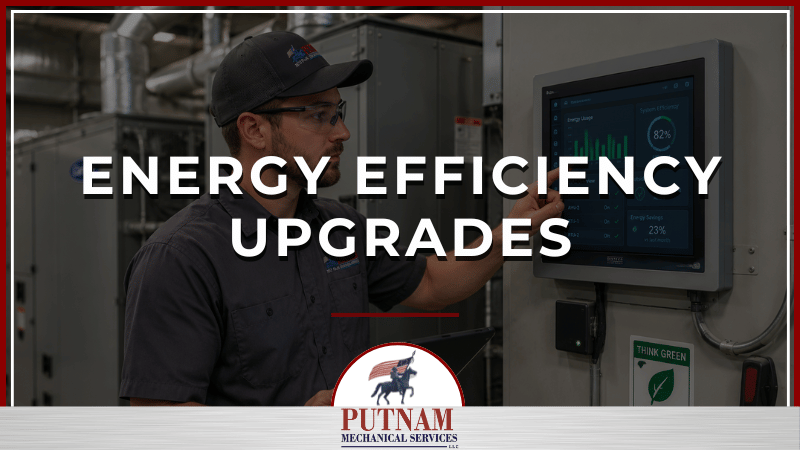
Commercial HVAC equipment is one of the largest line items on a Florida business's utility bill, and it is also one of the few that can be meaningfully reduced without sacrificing comfort. Systems that run nearly nonstop through a long cooling season offer significant opportunities for efficiency gains that simply are not available in milder climates.
Headquartered in Sarasota and serving Collier County, Hillsborough County, Lee County, Manatee County, Pinellas County, Sarasota County and the surrounding areas, Putnam Mechanical identifies and installs energy efficiency upgrades for commercial HVAC systems, from straightforward improvements like sealing duct leaks and replacing inefficient components to larger investments such as variable frequency drives, high-efficiency compressors, and economizer controls. We evaluate every recommendation against the actual return on investment, because an upgrade that takes fifteen years to pay for itself is rarely the right choice for a commercial property, while one that pays back in two or three years often is.
Not every efficiency upgrade makes financial sense for every commercial facility in Sarasota or across Collier, Hillsborough, Lee, Manatee, Pinellas, and Sarasota Counties and the surrounding areas. A VFD on a fan that already runs near full load most of the time will not deliver significant savings. An economizer in a building with poor outside-air ductwork might cost more to make functional than it saves. Before Putnam Mechanical recommends any upgrade, our Sarasota-based team reviews actual run-time patterns, your building’s current energy use, and the upgrade’s realistic payback period so the recommendation is based on your data, not a generic efficiency checklist.
Energy efficiency upgrades often extend equipment life as well as reduce operating costs. A VFD that allows a fan motor to run at a lower, steadier speed puts less mechanical stress on the motor than constant full-speed cycling. A properly functioning economizer reduces total compressor run hours, which means less wear over the system’s lifespan. When Putnam Mechanical recommends an efficiency upgrade for your facility in Sarasota, Bonita Springs, Bradenton, Brandon, Cape Coral, Clearwater, Estero, Fort Myers, Lakewood Ranch, Largo, Naples, North Port, Riverview, St. Petersburg, Tampa, Venice, and nearby communities, we are usually also reducing the load that leads to your next repair call.
Putnam Mechanical, headquartered in Sarasota, Florida, provides professional commercial refrigeration and HVAC services across Florida’s Gulf Coast, proudly serving Bonita Springs, Bradenton, Brandon, Cape Coral, Clearwater, Estero, Fort Myers, Lakewood Ranch, Largo, Naples, North Port, Riverview, Sarasota, St. Petersburg, Tampa, Venice, as well as Collier County, Hillsborough County, Lee County, Manatee County, Pinellas County, Sarasota County, and surrounding areas.
Our experienced team partners with business owners, property managers, facility teams, restaurants, grocery stores, healthcare facilities, hospitality properties, and retail operators to deliver essential repairs, replacements, system upgrades, and ongoing maintenance with minimal disruption to daily operations.
When refrigeration, HVAC, or ventilation equipment fails, the clock starts immediately. A walk-in cooler losing temperature, a freezer alarm going off, an ice machine failure, a rooftop unit shutting down, or a ventilation issue affecting airflow and building pressure can quickly impact inventory, comfort, safety, and revenue.
Putnam Mechanical provides 24-hour emergency commercial refrigeration, HVAC, and ventilation service with fast dispatch, on-site diagnostics, and clear repair recommendations.
Experiencing equipment failure right now? Call for priority dispatch.
It varies by building, but duct sealing and programmable scheduling controls are often among the quickest to pay for themselves, since they reduce wasted run time without requiring major equipment changes.
No — the goal of a properly evaluated upgrade is to reduce energy waste, not cooling capacity. Upgrades like VFDs and economizers are designed to maintain the same comfort level while running equipment more efficiently.
We look at the upgrade's installed cost against the estimated reduction in energy use based on your equipment's actual run-time patterns, giving you a realistic timeframe rather than a manufacturer's best-case estimate.
Availability varies by utility provider and changes over time. We can flag upgrades that commonly qualify for utility incentive programs, though you'll want to confirm current program details with your utility provider directly.
Many upgrades — duct sealing, programmable controls, economizer repair — work on existing equipment regardless of age. Others, like VFDs and high-efficiency compressors, may require equipment that's compatible with the upgrade. We'll assess your specific equipment before recommending anything.
From emergency walk-in cooler repair and refrigerant leak detection to rooftop unit service, compressor replacement, ductwork correction, ventilation support, preventative maintenance, and full system upgrades, our licensed Florida technicians are ready to respond.
COMMERCIAL HVAC ENERGY EFFICIENCY UPGRADES SARASOTA | REDUCE COOLING COSTS | VFD & ECONOMIZER INSTALLATION

Putnam Mechanical has proudly served commercial clients with dependable refrigeration and HVAC solutions. Headquartered in Sarasota, Florida, our experienced technicians specialize in commercial HVAC repair, refrigeration system installation and design, ice machine maintenance, compressor repair and replacement, controls and monitoring systems, energy efficiency upgrades, food safety and temperature compliance services, and 24/7 emergency service throughout Collier, Hillsborough, Lee, Manatee, Pinellas, Sarasota counties, and surrounding areas.
License # CAC1819526