
Refrigeration And HVAC Service That Keeps Your Sarasota, Florida Area Business Ahead Of Health Inspections, Not Behind Them
Licensed Putnam Mechanical Technicians | Documented Temperature And Compliance Logs | 24/7 Emergency Dispatch Throughout Sarasota, Florida And Surrounding Areas
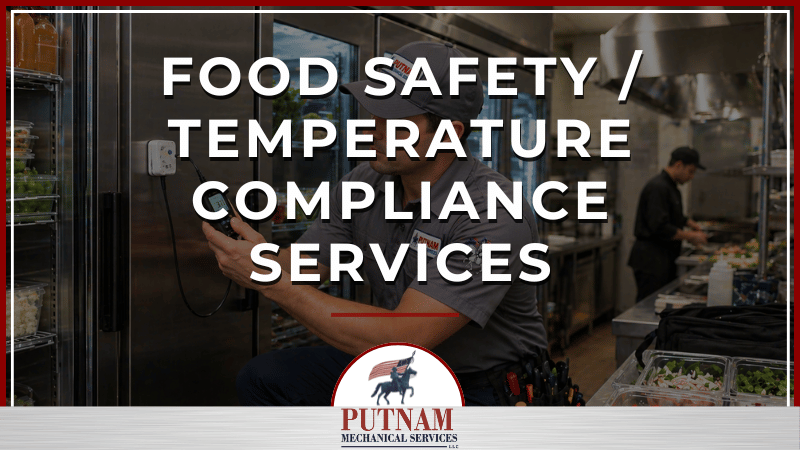
A health inspector will not accept “it was probably fine” as an answer, and neither should you. Temperature compliance for refrigerated and frozen food storage is not a once-a-year concern, it is a daily operational requirement that depends entirely on refrigeration equipment performing exactly as it should, every hour it is running.
Headquartered in Sarasota and serving Collier County, Hillsborough County, Lee County, Manatee County, Pinellas County, Sarasota County and surrounding areas, Putnam Mechanical services and maintains the commercial refrigeration equipment that food safety compliance depends on, including walk-in coolers, reach-ins, prep tables, and freezer units. Our experts calibrate equipment to hold accurate, stable temperatures, document service visits so you have clear records for inspectors, and provide rapid response when a unit drifts out of range so you can address issues before they become compliance failures or costly discarded inventory losses.
Health inspections typically verify that cold storage is holding at or below 41°F and that frozen storage remains at or below 0°F, along with confirming that thermometers are present, accurate, and clearly visible. Equipment that is gradually losing efficiency, such as a failing door seal, a coil needing defrost, or a thermostat drifting out of calibration, can still appear to be operating normally while actually running several degrees warmer than the display indicates. Regular service from the commercial refrigeration experts at Putnam Mechanical in Sarasota helps identify and correct that temperature drift before an inspector does, protecting your operation across Collier, Hillsborough, Lee, Manatee, Pinellas, Sarasota Counties and surrounding areas.
A repair without a record provides little support when an inspector asks for your maintenance history. Putnam Mechanical, headquartered in Sarasota and serving all of Collier, Hillsborough, Lee, Manatee, Pinellas, Sarasota Counties and surrounding communities, supplies detailed documentation for every service visit: what was checked, what was found, and what was corrected. This clear paper trail demonstrates that your commercial refrigeration and HVAC equipment is actively maintained, not only serviced when something finally fails.
Putnam Mechanical, headquartered in Sarasota, Florida, provides professional commercial refrigeration and HVAC services across Florida’s Gulf Coast, proudly serving Bonita Springs, Bradenton, Brandon, Cape Coral, Clearwater, Estero, Fort Myers, Lakewood Ranch, Largo, Naples, North Port, Riverview, Sarasota, St. Petersburg, Tampa, Venice, as well as Collier County, Hillsborough County, Lee County, Manatee County, Pinellas County, Sarasota County, and surrounding areas.
Our experienced team partners with business owners, property managers, facility teams, restaurants, grocery stores, healthcare facilities, hospitality properties, and retail operators to deliver essential repairs, replacements, system upgrades, and ongoing maintenance with minimal disruption to daily operations.
When refrigeration, HVAC, or ventilation equipment fails, the clock starts immediately. A walk-in cooler losing temperature, a freezer alarm going off, an ice machine failure, a rooftop unit shutting down, or a ventilation issue affecting airflow and building pressure can quickly impact inventory, comfort, safety, and revenue.
Putnam Mechanical provides 24-hour emergency commercial refrigeration, HVAC, and ventilation service with fast dispatch, on-site diagnostics, and clear repair recommendations.
Experiencing equipment failure right now? Call for priority dispatch.
General guidance calls for cold storage at or below 41°F and frozen storage at or below 0°F, though exact requirements can vary by local health code. We can help you confirm the standard that applies to your jurisdiction.
Yes. We document service visits, including readings and any corrections made, so you have a record of active maintenance available if requested during an inspection.
This depends on your equipment and business type, but regular scheduled checks — rather than waiting for a visible problem — are what actually prevent inspection-day surprises.
Don't wait. A unit that's drifting warm before it fails completely is exactly the situation where a service call can prevent a compliance issue or inventory loss — call before it becomes an emergency, not after.
Both. We install monitoring systems with automated alerts so problems get caught in real time, in addition to providing repair and calibration service.
From emergency walk-in cooler repair and refrigerant leak detection to rooftop unit service, compressor replacement, ductwork correction, ventilation support, preventative maintenance, and full system upgrades, our licensed Florida technicians are ready to respond.
FOOD SAFETY TEMPERATURE COMPLIANCE SARASOTA FLORIDA | COMMERCIAL REFRIGERATION SERVICE | HEALTH INSPECTION READY

Putnam Mechanical has proudly served commercial clients with dependable refrigeration and HVAC solutions. Headquartered in Sarasota, Florida, our experienced technicians specialize in commercial HVAC repair, refrigeration system installation and design, ice machine maintenance, compressor repair and replacement, controls and monitoring systems, energy efficiency upgrades, food safety and temperature compliance services, and 24/7 emergency service throughout Collier, Hillsborough, Lee, Manatee, Pinellas, Sarasota counties, and surrounding areas.
License # CAC1819526