
Fixing Leaks, Damage, And Airflow Loss In Commercial Duct Systems Across Sarasota, Florida And Surrounding Areas
Licensed Putnam Mechanical HVAC Technicians | Energy Loss Diagnostics | Code-Compliant Repairs
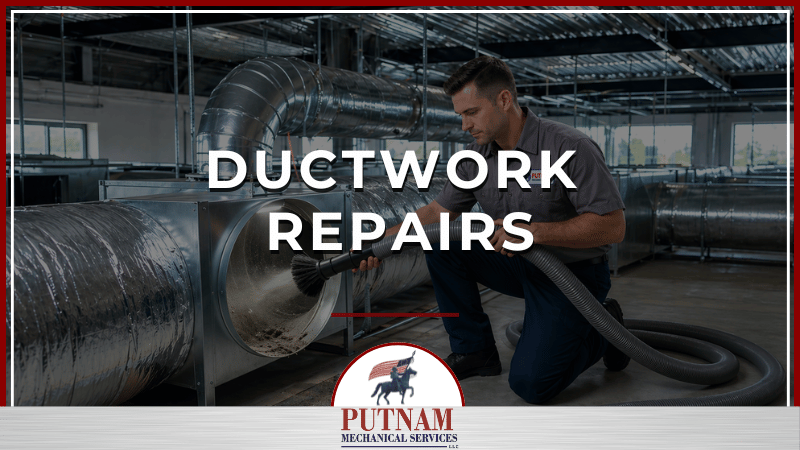
Ductwork often goes unnoticed until there is a visible problem, yet leaking or damaged ducts are one of the most common reasons a commercial HVAC system runs constantly without ever fully cooling the building. Air that should be reaching a sales floor, kitchen, or office space can instead escape into a ceiling cavity, attic, or mechanical room, driving up energy costs while failing to deliver comfort where it is needed.
Based in Sarasota and serving businesses throughout Collier County, Hillsborough County, Lee County, Manatee County, Pinellas County, Sarasota County and surrounding areas, Putnam Mechanical inspects, repairs, and seals commercial ductwork for a wide range of facilities. Our refrigeration and HVAC experts locate leaks at duct joints, damaged sections, and disconnected runs, then repair or reseal them to restore the airflow your system was originally designed to provide. When ductwork is deteriorated beyond practical repair, which is common in older commercial buildings with decades of wear, we install replacement runs that are properly sized for current building use rather than simply duplicating the existing layout.
For commercial facilities in Sarasota and throughout Collier, Hillsborough, Lee, Manatee, Pinellas, Sarasota Counties and surrounding areas, a duct system losing even 15 to 20% of conditioned air to leaks, which is common in older commercial ductwork, forces the HVAC equipment to run longer and harder to maintain the same comfort level. This shows up directly as higher utility costs. It also means the equipment is operating under more strain than its design load allows, which can shorten compressor and motor life. Sealing and repairing ductwork with the commercial HVAC experts at Putnam Mechanical, headquartered in Sarasota and serving all of these counties, is often one of the most cost-effective improvements for an older commercial building because it reduces load on equipment that does not need to be replaced just to correct an airflow problem.
For many commercial properties in Sarasota and across Collier, Hillsborough, Lee, Manatee, Pinellas, Sarasota Counties and surrounding areas, sealing and patching is usually the right choice for isolated leaks, loose joints, or sections with manageable damage. Full or partial duct replacement makes more sense when insulation has failed throughout the system, when ductwork was undersized or poorly routed during the original installation, or when a renovation has changed the building layout enough that the existing duct paths no longer match current room use. Putnam Mechanical, your Sarasota-based commercial refrigeration and HVAC experts, carefully evaluates actual duct condition and airflow performance before recommending the repair or replacement approach that makes the most sense for your building.
Putnam Mechanical, headquartered in Sarasota, Florida, provides professional commercial refrigeration and HVAC services across Florida’s Gulf Coast, proudly serving Bonita Springs, Bradenton, Brandon, Cape Coral, Clearwater, Estero, Fort Myers, Lakewood Ranch, Largo, Naples, North Port, Riverview, Sarasota, St. Petersburg, Tampa, Venice, as well as Collier County, Hillsborough County, Lee County, Manatee County, Pinellas County, Sarasota County, and surrounding areas.
Our experienced team partners with business owners, property managers, facility teams, restaurants, grocery stores, healthcare facilities, hospitality properties, and retail operators to deliver essential repairs, replacements, system upgrades, and ongoing maintenance with minimal disruption to daily operations.
When refrigeration, HVAC, or ventilation equipment fails, the clock starts immediately. A walk-in cooler losing temperature, a freezer alarm going off, an ice machine failure, a rooftop unit shutting down, or a ventilation issue affecting airflow and building pressure can quickly impact inventory, comfort, safety, and revenue.
Putnam Mechanical provides 24-hour emergency commercial refrigeration, HVAC, and ventilation service with fast dispatch, on-site diagnostics, and clear repair recommendations.
Experiencing equipment failure right now? Call for priority dispatch.
Signs of damaged ductwork include uneven temperatures, weak airflow, excessive dust, rising energy costs, unusual noises, and HVAC systems that struggle to maintain consistent indoor comfort. A professional inspection can identify leaks, damaged sections, or airflow restrictions.
Yes. Leaking or damaged ductwork forces your commercial HVAC system to work harder, increasing energy consumption and operating costs. Repairing ductwork helps improve efficiency and overall system performance.
Putnam Mechanical repairs leaking ducts, damaged duct sections, loose connections, insulation issues, airflow restrictions, and other ductwork problems that impact the performance of commercial HVAC systems.
Yes. We provide commercial ductwork repairs for restaurants, office buildings, retail centers, healthcare facilities, warehouses, hotels, industrial facilities, schools, and many other commercial properties throughout our service area.
Absolutely. Properly repaired ductwork helps restore balanced airflow, eliminate hot and cold spots, improve indoor comfort, reduce strain on HVAC equipment, and support more efficient operation throughout your commercial building.
From emergency walk-in cooler repair and refrigerant leak detection to rooftop unit service, compressor replacement, ductwork correction, ventilation support, preventative maintenance, and full system upgrades, our licensed Florida technicians are ready to respond.
COMMERCIAL DUCTWORK REPAIR SARASOTA | DUCT SEALING & REPLACEMENT | AIRFLOW & ENERGY LOSS CORRECTION

Putnam Mechanical has proudly served commercial clients with dependable refrigeration and HVAC solutions. Headquartered in Sarasota, Florida, our experienced technicians specialize in commercial HVAC repair, refrigeration system installation and design, ice machine maintenance, compressor repair and replacement, controls and monitoring systems, energy efficiency upgrades, food safety and temperature compliance services, and 24/7 emergency service throughout Collier, Hillsborough, Lee, Manatee, Pinellas, Sarasota counties, and surrounding areas.
License # CAC1819526