
Protecting Inventory And Food Safety Compliance With Fast, Accurate Diagnostics
Licensed Technicians | Stocked Parts | 24/7 Emergency HVAC Service Throughout Sarasota, Florida And Surrounding Areas
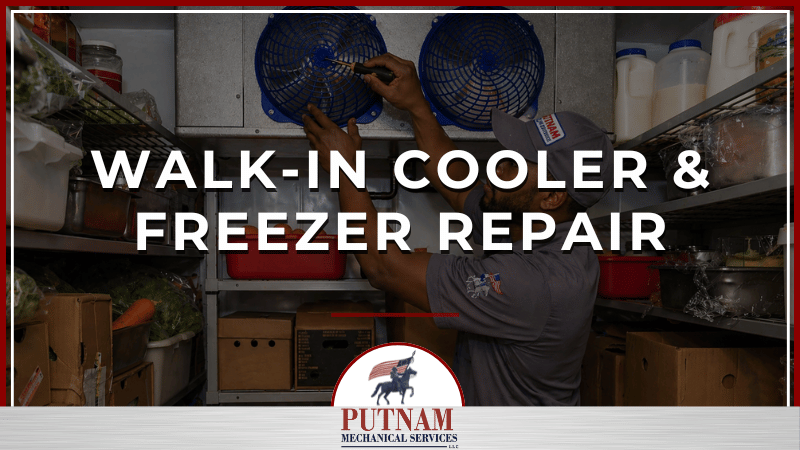
A walk-in cooler or freezer failure puts a clock on everything inside it. Unlike most equipment failures, this one has a direct food safety deadline attached, and it often happens overnight or over a weekend, when the problem is not discovered until someone opens the door the next morning to a unit that has been climbing in temperature for hours.
Headquartered in Sarasota and serving Collier County, Hillsborough County, Lee County, Manatee County, Pinellas County, Sarasota County and surrounding areas, Putnam Mechanical provides fast walk-in cooler and freezer repair for commercial facilities. Our refrigeration experts quickly identify the true point of failure, whether it is a failing compressor, a refrigerant leak, a defrost system malfunction, or a door seal letting warm air in, and resolve it before more inventory is at risk. Our service vehicles are stocked with commonly needed parts so most repairs are completed in a single visit.
A failed rooftop unit makes a building uncomfortable. A failed walk-in cooler or freezer puts every item inside it on a countdown, and the stakes only grow the longer it goes unaddressed: spoiled inventory, potential health-code violations, and product losses that are often far higher than the cost of the repair. That is why Putnam Mechanical, headquartered in Sarasota and serving Collier, Hillsborough, Lee, Manatee, Pinellas, Sarasota Counties and surrounding areas, treats walk-in failures as priority calls on our 24/7 emergency line rather than routine service requests.
Keep the door closed as much as possible to slow the temperature rise, and avoid adding new inventory to the unit until it is repaired. If you are not sure whether food that has already been exposed to a temperature rise is still safe, follow standard food-safety guidance on time and temperature limits rather than guessing. When in doubt, it is safer to discard product than risk a food-safety issue.
Putnam Mechanical, headquartered in Sarasota, Florida, provides professional commercial refrigeration and HVAC services across Florida’s Gulf Coast, proudly serving Bonita Springs, Bradenton, Brandon, Cape Coral, Clearwater, Estero, Fort Myers, Lakewood Ranch, Largo, Naples, North Port, Riverview, Sarasota, St. Petersburg, Tampa, Venice, as well as Collier County, Hillsborough County, Lee County, Manatee County, Pinellas County, Sarasota County, and surrounding areas.
Our experienced team partners with business owners, property managers, facility teams, restaurants, grocery stores, healthcare facilities, hospitality properties, and retail operators to deliver essential repairs, replacements, system upgrades, and ongoing maintenance with minimal disruption to daily operations.
When refrigeration, HVAC, or ventilation equipment fails, the clock starts immediately. A walk-in cooler losing temperature, a freezer alarm going off, an ice machine failure, a rooftop unit shutting down, or a ventilation issue affecting airflow and building pressure can quickly impact inventory, comfort, safety, and revenue.
Putnam Mechanical provides 24-hour emergency commercial refrigeration, HVAC, and ventilation service with fast dispatch, on-site diagnostics, and clear repair recommendations.
Experiencing equipment failure right now? Call for priority dispatch.
Yes. We stock commonly needed components in our service vehicles, which means most repairs are completed in a single visit rather than requiring a return trip.
Regular preventative maintenance — checking refrigerant levels, door seals, and coil condition — catches most developing problems before they cause a full breakdown. We can recommend a schedule based on your specific equipment and usage.
It depends on the unit's age, repair history, and the specific failure. We'll give you a direct comparison rather than defaulting to whichever option costs more.
This is commonly caused by a refrigerant leak, a failing compressor, a dirty condenser coil restricting airflow, or a door seal that's letting warm air in continuously. A diagnostic visit can identify the specific cause.
Our emergency dispatch line operates 24/7, and walk-in failures are treated as priority calls given the food-safety risk involved.
From emergency walk-in cooler repair and refrigerant leak detection to rooftop unit service, compressor replacement, ductwork correction, ventilation support, preventative maintenance, and full system upgrades, our licensed Florida technicians are ready to respond.
WALK-IN COOLER & FREEZER REPAIR SARASOTA | EMERGENCY REFRIGERATION SERVICE | 24/7 DISPATCH

Putnam Mechanical has proudly served commercial clients with dependable refrigeration and HVAC solutions. Headquartered in Sarasota, Florida, our experienced technicians specialize in commercial HVAC repair, refrigeration system installation and design, ice machine maintenance, compressor repair and replacement, controls and monitoring systems, energy efficiency upgrades, food safety and temperature compliance services, and 24/7 emergency service throughout Collier, Hillsborough, Lee, Manatee, Pinellas, Sarasota counties, and surrounding areas.
License # CAC1819526