Rooftop units, package systems, split systems and multi-zone equipment, diagnosed properly the first time.
Same-day and next-business-day scheduling · 24/7 emergency dispatch · Common parts stocked in Sarasota
Commercial HVAC repair
When a rooftop unit fails on a Florida afternoon, there’s usually little warning, one moment it’s cooling, the next it’s short-cycling, tripping breakers, or pushing warm air into a building full of customers or employees. Commercial HVAC repair has to happen quickly, but speed without an accurate diagnosis only leads to repeat breakdowns and more service calls.
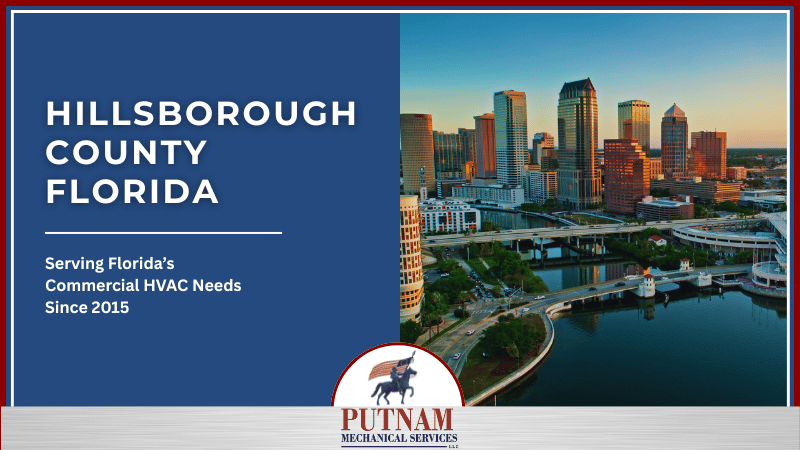
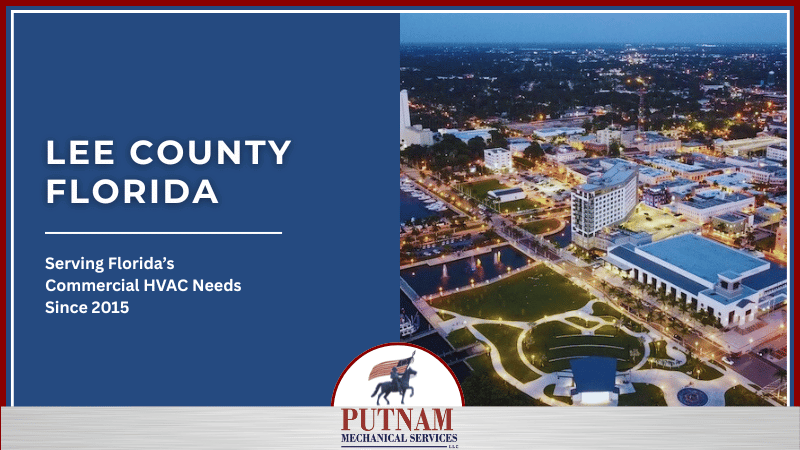
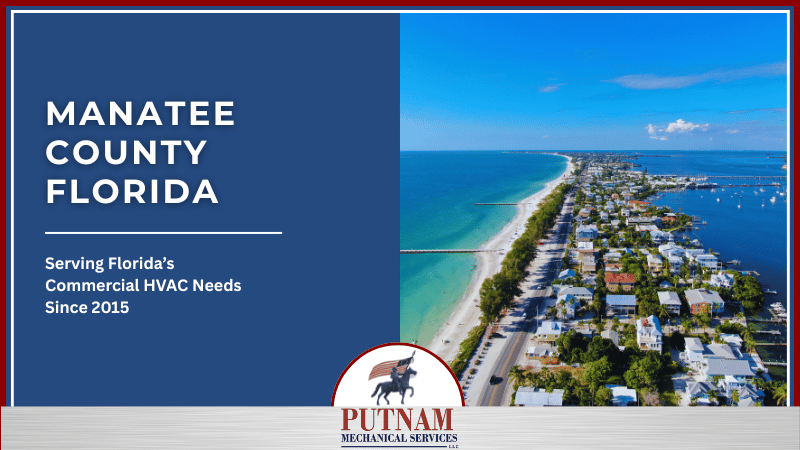
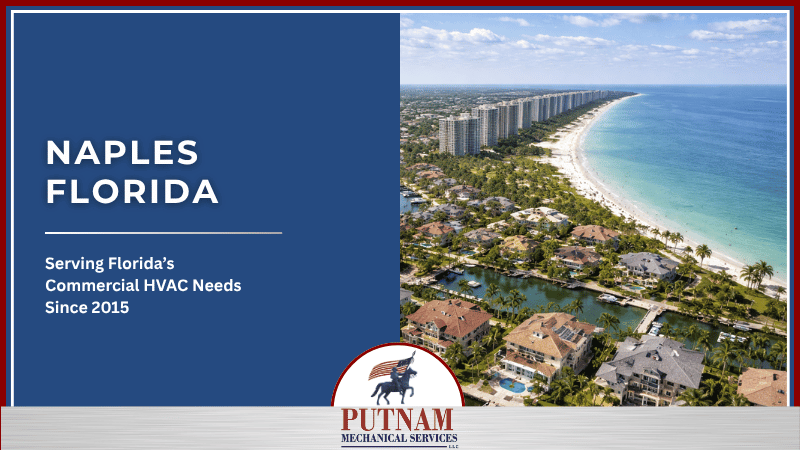
Headquartered in Sarasota and serving businesses throughout Collier County, Hillsborough County, Lee County, Manatee County, Pinellas County, Sarasota County and the surrounding areas, Putnam Mechanical delivers expert commercial HVAC repair for rooftop units, package systems, split systems, and multi-zone equipment along Florida’s Gulf Coast. Our technicians identify the true point of failure, whether it’s a failing capacitor, a refrigerant leak, a control board fault, or a clogged condensate line, before recommending repairs, so you are not paying for parts or labor that won’t actually fix the issue. With a well-stocked warehouse of common commercial components, most repairs are completed in a single visit instead of waiting on special-order parts.
Because commercial HVAC problems rarely occur on a convenient schedule, our repair experts are supported by a 24/7 emergency dispatch line for businesses that can’t wait until the next business day.
Putnam Mechanical LLC · 7228 21st St E, Sarasota, FL 34243 · 941-280-4440
Common failure points
Based in Sarasota and serving Collier, Hillsborough, Lee, Manatee, Pinellas, Sarasota Counties and surrounding areas, Putnam Mechanical provides expert commercial HVAC repair for:
Emergency calls with no cooling, electrical hazards or safety issues are dispatched through our 24/7 line and prioritised over routine scheduling. Routine repairs are typically scheduled same day or next business day.
Our method
Every service call begins with a structured diagnostic process. Our Sarasota-based commercial HVAC experts check refrigerant pressures, electrical readings, airflow, and control signals to identify the true cause of the failure instead of guessing from symptoms. This is especially important in commercial systems, where a single rooftop unit often includes more components such as economizers, multiple compressors, and staged controls that can fail independently. Without a methodical check of each subsystem, someone might replace a part, see the unit run briefly, and then face another breakdown when the underlying issue returns.
Not every failure calls for a full system replacement, and not every repair is a smart investment on an older unit. As a general guideline, equipment under about 10 years old with a contained, clearly identifiable failure is usually a strong candidate for repair. Equipment past 12 to 15 years of Florida runtime, especially with a history of repeat repairs or a refrigerant type that is being phased out, often makes more financial sense to replace. The decision typically comes down to repair cost compared with remaining useful life and the increasing risk of future failures. Putnam Mechanical will provide that comparison honestly so you can choose what is best for your facility, rather than steering you toward whichever option would be more profitable for us.
No cooling, temperature loss, electrical hazard or a system failure affecting your business? Call for priority dispatch.
Related Commercial Services
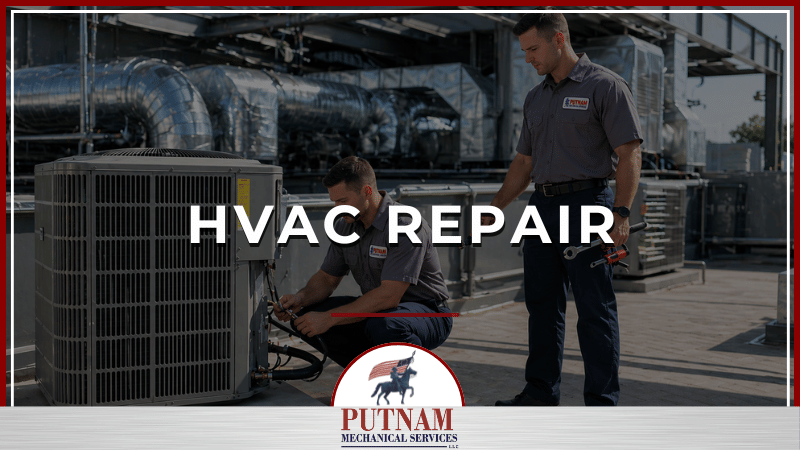
Rooftop, split, multi-zone, VRF and ductless mini-split systems, each diagnosed on its own terms.
Learn More →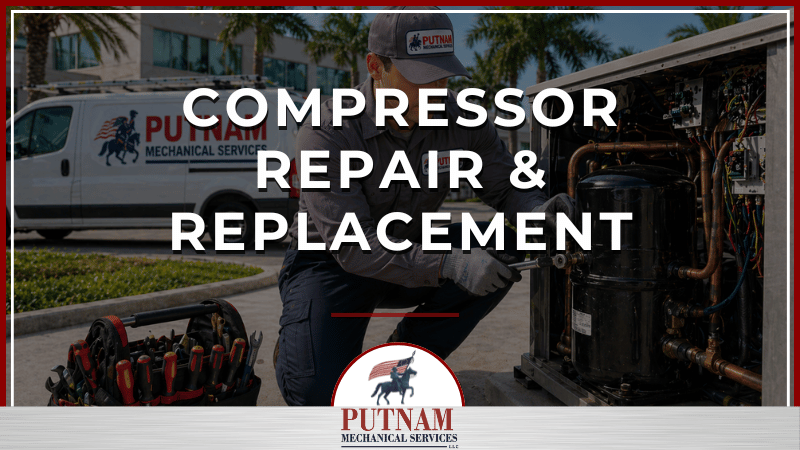
Compressors usually fail for a reason. We find the reason before replacing the part.
Learn More →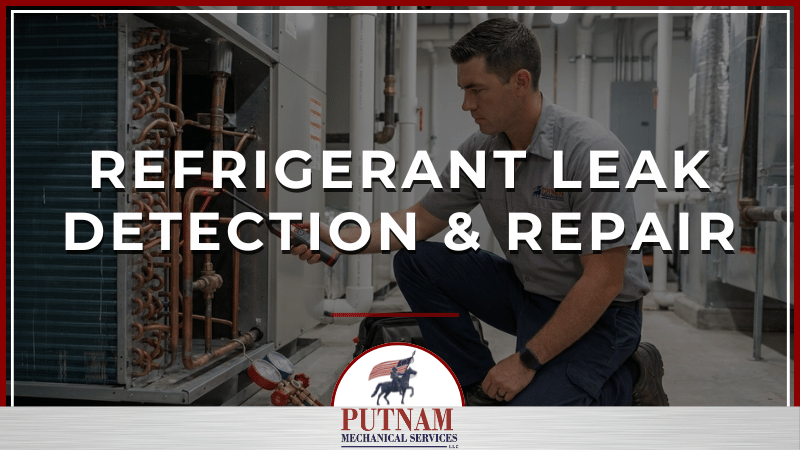
Low charge means a leak. Topping it off is not a repair, and the compressor pays for it.
Learn More →
A live dispatch line, any hour of any day, for failures that cannot wait until Monday.
Learn More →
Most failures give warning signs first. Planned maintenance is how you find them early.
Learn More →
The same technicians handle refrigeration, so a multi-system property calls one vendor.
Learn More →Serving Florida's Gulf Coast
Headquartered in Sarasota and serving businesses throughout Collier, Hillsborough, Lee, Manatee, Pinellas and Sarasota counties and the surrounding areas, including Tampa, St. Petersburg, Bradenton, Venice, Fort Myers, Naples, Cape Coral, Clearwater, Largo, Lakewood Ranch, North Port, Bonita Springs, Estero, Riverview and Brandon.
Putnam Mechanical LLC · License # CAC1819526 · 7228 21st St E, Sarasota, FL 34243 · Licensed, insured and EPA-certified
Routine repairs are typically scheduled within the same day or next business day. Emergency calls — no cooling, electrical hazards, or safety issues — are dispatched through our 24/7 emergency line and prioritized over routine scheduling.
We stock common commercial HVAC components — capacitors, contactors, control boards, motors — in our warehouse, so most repairs are completed in a single visit. Less common or manufacturer-specific parts may require ordering, which we'll tell you upfront.
We weigh the age of the equipment, the cost of the repair, the unit's repair history, and its remaining expected service life, and walk you through that comparison directly rather than pushing one option.
Yes. You'll get a diagnosis and a cost estimate before any repair work begins, so there are no surprises on the invoice.
Yes. Our preventative maintenance plans are designed to catch wear and failing components before they cause an unplanned breakdown, give us a call for details.
From emergency walk-in cooler repair and refrigerant leak detection to rooftop unit service, compressor replacement, ductwork correction, ventilation support, preventative maintenance, and full system upgrades, our licensed Florida technicians are ready to respond.

Putnam Mechanical has proudly served commercial clients with dependable refrigeration and HVAC solutions. Headquartered in Sarasota, Florida, our experienced technicians specialize in commercial HVAC repair, refrigeration system installation and design, ice machine maintenance, compressor repair and replacement, controls and monitoring systems, energy efficiency upgrades, food safety and temperature compliance services, and 24/7 emergency service throughout Collier, Hillsborough, Lee, Manatee, Pinellas, Sarasota counties, and surrounding areas.
License # CAC1819526